StudyNest
Marketplace
Learning app for university and community courses that turns “I want to study this today” into guided practice with quizzes and explanations.
Learning app for university and community courses that turns “I want to study this today” into guided practice with quizzes and explanations.
Project Manager & System Strategist
Project Manager & System Strategist
Jan 2025 – Apr 2025
Jan 2025 – Apr 2025
Figma, React Native (Expo), Firebase, Neon Postgres + Drizzle, Stripe, SendGrid, Gemini API (for quiz generation)
Figma, React Native (Expo), Firebase, Neon Postgres + Drizzle, Stripe, SendGrid, Gemini API (for quiz generation)

Overview
Overview
Turning daily study intentions into guided practice
Turning daily study intentions into guided practice

StudyNest is a community driven learning app that supports both university courses and independent communities. Instead of forcing students into a fixed curriculum, StudyNest begins from a simple input about what they want to study on that day. From there, the system generates quizzes and explanations so students can practice more consistently without spending extra energy to design every study session.
As Project Manager and System Strategist, I worked across product flows, system behavior, and close collaboration with the backend team. My focus was to turn scattered habits such as group chats, shared notes, and last minute study sessions into a calm and shared structure that feels supportive rather than strict. Behind the scenes, StudyNest uses Firebase for authentication, Neon Postgres with Drizzle for course and progress data, and a backend that integrates Stripe for payments and SendGrid for email. This makes the product ready for real courses and real communities.
StudyNest is a community driven learning app that supports both university courses and independent communities. Instead of forcing students into a fixed curriculum, StudyNest begins from a simple input about what they want to study on that day. From there, the system generates quizzes and explanations so students can practice more consistently without spending extra energy to design every study session.
As Project Manager and System Strategist, I worked across product flows, system behavior, and close collaboration with the backend team. My focus was to turn scattered habits such as group chats, shared notes, and last minute study sessions into a calm and shared structure that feels supportive rather than strict. Behind the scenes, StudyNest uses Firebase for authentication, Neon Postgres with Drizzle for course and progress data, and a backend that integrates Stripe for payments and SendGrid for email. This makes the product ready for real courses and real communities.
StudyNest is a community driven learning app that supports both university courses and independent communities. Instead of forcing students into a fixed curriculum, StudyNest begins from a simple input about what they want to study on that day. From there, the system generates quizzes and explanations so students can practice more consistently without spending extra energy to design every study session.
As Project Manager and System Strategist, I worked across product flows, system behavior, and close collaboration with the backend team. My focus was to turn scattered habits such as group chats, shared notes, and last minute study sessions into a calm and shared structure that feels supportive rather than strict. Behind the scenes, StudyNest uses Firebase for authentication, Neon Postgres with Drizzle for course and progress data, and a backend that integrates Stripe for payments and SendGrid for email. This makes the product ready for real courses and real communities.
Challenge
Good intentions, weak structure
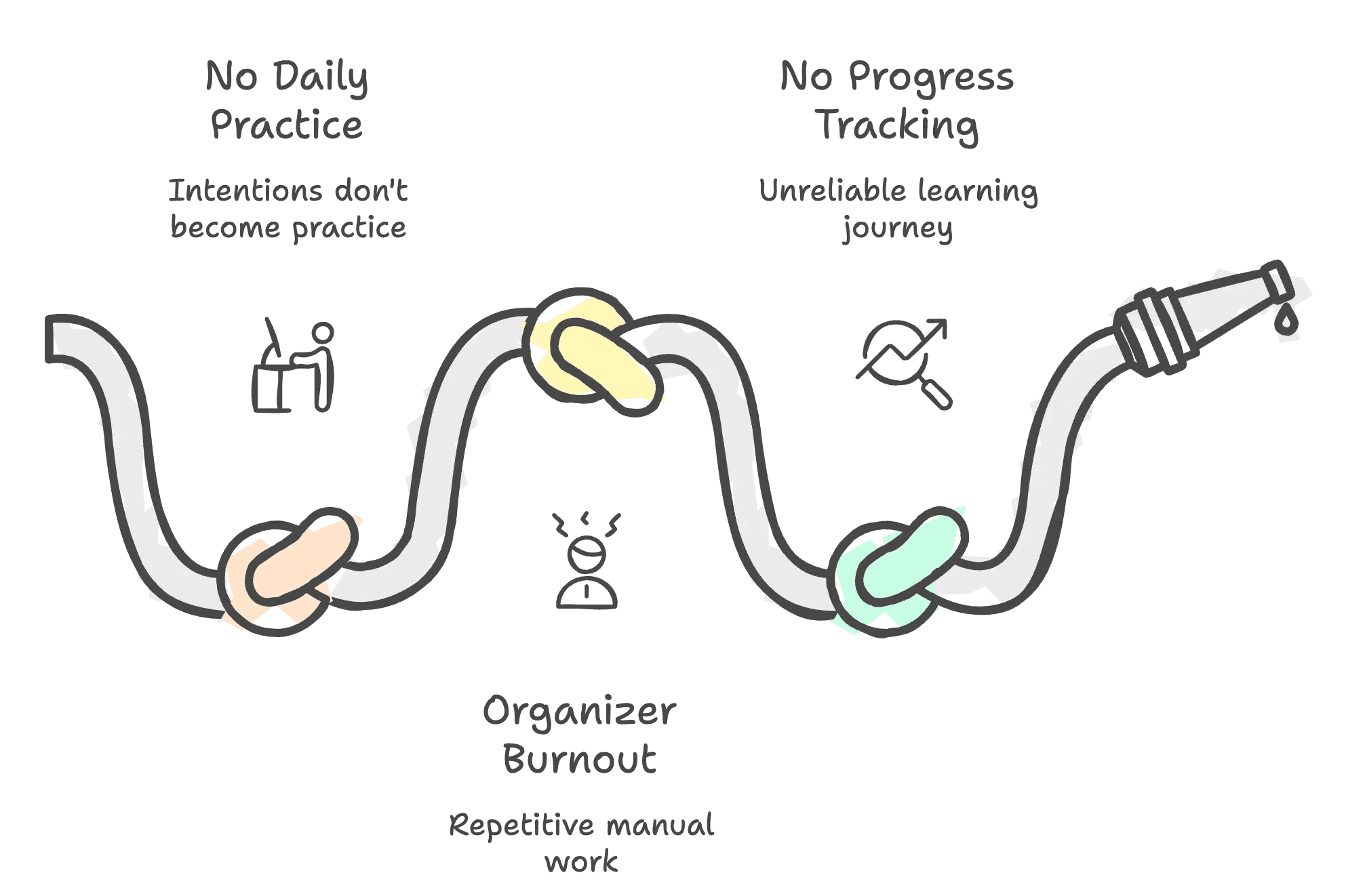
Motivation was not the main problem. Many students already had good intentions. They joined group chats, collected shared notes, and rushed into study sessions before exams. The real issue was the lack of light structure. Students often said that they needed to study a certain topic, but they did not have enough time or energy to turn that intention into clear daily practice with feedback.
On the community and course side, organizers found it hard to keep people engaged over time. Running a special course or study group across several cohorts meant repeating the same manual work again and again. They had to plan sessions, prepare questions, send reminders, and track who was actually making progress. Chat applications and static documents were helpful, but they did not give a reliable view of each student’s position in the learning journey.
The challenge for StudyNest was to respect how students already study together and to add only the amount of structure and automation that makes staying on track feel simple instead of heavy.
Motivation was not the main problem. Many students already had good intentions. They joined group chats, collected shared notes, and rushed into study sessions before exams. The real issue was the lack of light structure. Students often said that they needed to study a certain topic, but they did not have enough time or energy to turn that intention into clear daily practice with feedback.
On the community and course side, organizers found it hard to keep people engaged over time. Running a special course or study group across several cohorts meant repeating the same manual work again and again. They had to plan sessions, prepare questions, send reminders, and track who was actually making progress. Chat applications and static documents were helpful, but they did not give a reliable view of each student’s position in the learning journey.
The challenge for StudyNest was to respect how students already study together and to add only the amount of structure and automation that makes staying on track feel simple instead of heavy.
Motivation was not the main problem. Many students already had good intentions. They joined group chats, collected shared notes, and rushed into study sessions before exams. The real issue was the lack of light structure. Students often said that they needed to study a certain topic, but they did not have enough time or energy to turn that intention into clear daily practice with feedback.
On the community and course side, organizers found it hard to keep people engaged over time. Running a special course or study group across several cohorts meant repeating the same manual work again and again. They had to plan sessions, prepare questions, send reminders, and track who was actually making progress. Chat applications and static documents were helpful, but they did not give a reliable view of each student’s position in the learning journey.
The challenge for StudyNest was to respect how students already study together and to add only the amount of structure and automation that makes staying on track feel simple instead of heavy.
Strategy
Layering AI and workflow on top of real habits
Layering AI and workflow on top of real habits
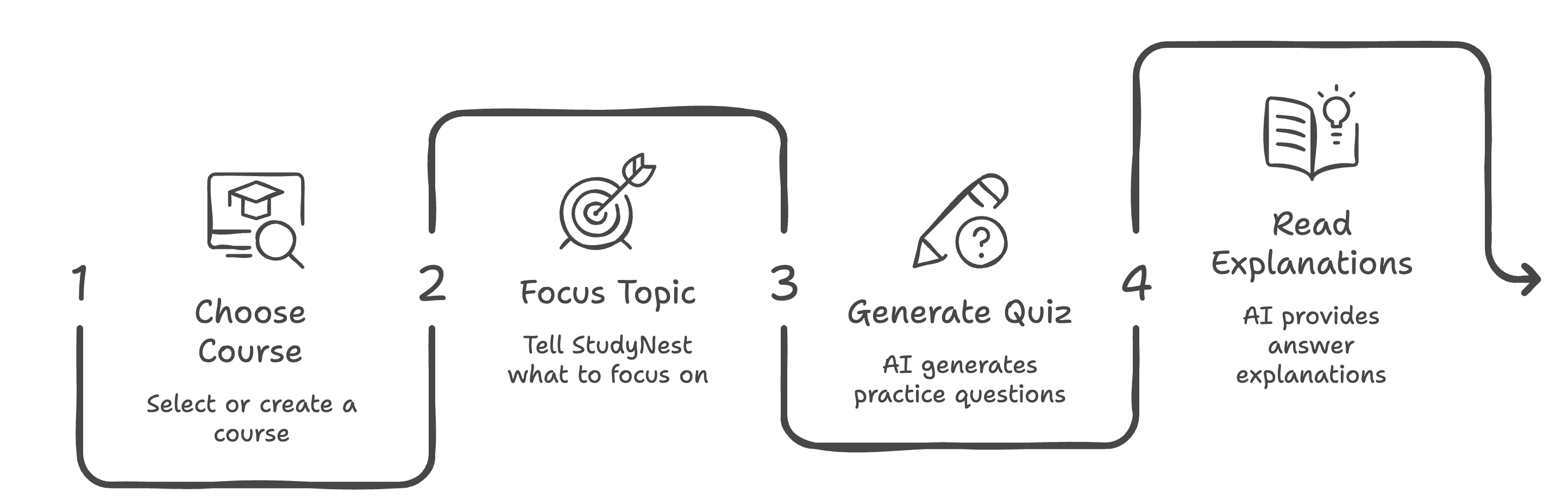
With StudyNest, I designed a light workflow that fits on top of what students already do. It connects naturally with existing behavior such as chats, shared notes, and last minute study sessions. The system allows the AI layer to handle the repetitive work that includes generating practice questions and explanations.
The core interaction is intentionally simple so that students do not feel blocked by the tool. Students and communities can choose or create a course, then tell StudyNest what they want to focus on on that day. The backend calls the Gemini API to generate quizzes and answer explanations around that topic. At the same time, the app keeps track of attempts and progress over time. This turns vague thoughts about studying a chapter into concrete steps such as taking a quiz, reading explanations, and seeing how today’s work fits into the wider learning journey.
From a systems perspective, I worked with a backend that uses Neon Postgres with Drizzle as the main source of truth for courses, sessions, and progress. Firebase is responsible for authentication and basic identity across devices. Stripe supports paid courses or community offerings. SendGrid supports transactional email such as confirmations and reminders. My role was to align user flows with these technical building blocks so that the product feels simple on the surface while the structure behind it stays organized and scalable.
With StudyNest, I designed a light workflow that fits on top of what students already do. It connects naturally with existing behavior such as chats, shared notes, and last minute study sessions. The system allows the AI layer to handle the repetitive work that includes generating practice questions and explanations.
The core interaction is intentionally simple so that students do not feel blocked by the tool. Students and communities can choose or create a course, then tell StudyNest what they want to focus on on that day. The backend calls the Gemini API to generate quizzes and answer explanations around that topic. At the same time, the app keeps track of attempts and progress over time. This turns vague thoughts about studying a chapter into concrete steps such as taking a quiz, reading explanations, and seeing how today’s work fits into the wider learning journey.
From a systems perspective, I worked with a backend that uses Neon Postgres with Drizzle as the main source of truth for courses, sessions, and progress. Firebase is responsible for authentication and basic identity across devices. Stripe supports paid courses or community offerings. SendGrid supports transactional email such as confirmations and reminders. My role was to align user flows with these technical building blocks so that the product feels simple on the surface while the structure behind it stays organized and scalable.
With StudyNest, I designed a light workflow that fits on top of what students already do. It connects naturally with existing behavior such as chats, shared notes, and last minute study sessions. The system allows the AI layer to handle the repetitive work that includes generating practice questions and explanations.
The core interaction is intentionally simple so that students do not feel blocked by the tool. Students and communities can choose or create a course, then tell StudyNest what they want to focus on on that day. The backend calls the Gemini API to generate quizzes and answer explanations around that topic. At the same time, the app keeps track of attempts and progress over time. This turns vague thoughts about studying a chapter into concrete steps such as taking a quiz, reading explanations, and seeing how today’s work fits into the wider learning journey.
From a systems perspective, I worked with a backend that uses Neon Postgres with Drizzle as the main source of truth for courses, sessions, and progress. Firebase is responsible for authentication and basic identity across devices. Stripe supports paid courses or community offerings. SendGrid supports transactional email such as confirmations and reminders. My role was to align user flows with these technical building blocks so that the product feels simple on the surface while the structure behind it stays organized and scalable.
Impact
From random effort to more consistent practice
From random effort to more consistent practice
Even as a student project, aligning real behavior with a clearer workflow created tangible improvements in how people thought about studying:
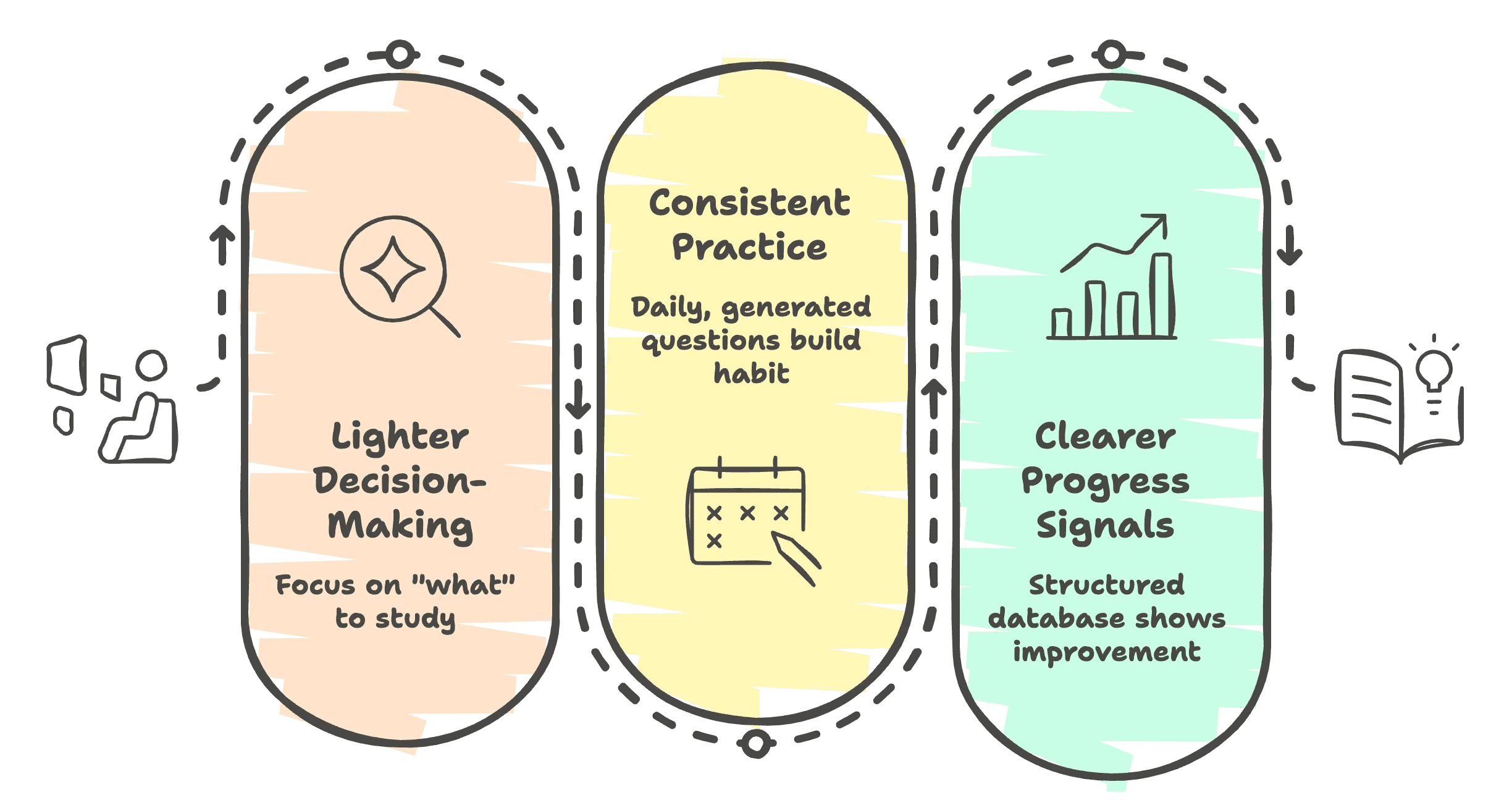
Lighter decision-making: instead of deciding how to study each day, students only needed to decide what topic to focus on. StudyNest handled the quiz generation and explanations.
More consistent practice: framing each day around a small generated set of questions made it easier to build a habit, especially for communities running courses over several weeks.
Clearer progress signals: storing attempts and results in a structured database made it possible to show simple, honest progress over time, instead of leaving students guessing whether they were actually improving.
Ready for real usage: using a backend stack with Firebase, Neon Postgres with Drizzle, Stripe, and SendGrid meant the product could support real communities, paid courses, and reliable communication without rewriting the core.
These effects showed me that even small layers of structure, when combined with AI generation and a solid backend, can shift learning from “random bursts of effort” into something more sustainable.
Even as a student project, aligning real behavior with a clearer workflow created tangible improvements in how people thought about studying:
Lighter decision-making: instead of deciding how to study each day, students only needed to decide what topic to focus on. StudyNest handled the quiz generation and explanations.
More consistent practice: framing each day around a small generated set of questions made it easier to build a habit, especially for communities running courses over several weeks.
Clearer progress signals: storing attempts and results in a structured database made it possible to show simple, honest progress over time, instead of leaving students guessing whether they were actually improving.
Ready for real usage: using a backend stack with Firebase, Neon Postgres with Drizzle, Stripe, and SendGrid meant the product could support real communities, paid courses, and reliable communication without rewriting the core.
These effects showed me that even small layers of structure, when combined with AI generation and a solid backend, can shift learning from “random bursts of effort” into something more sustainable.
Even as a student project, aligning real behavior with a clearer workflow created tangible improvements in how people thought about studying:
Lighter decision-making: instead of deciding how to study each day, students only needed to decide what topic to focus on. StudyNest handled the quiz generation and explanations.
More consistent practice: framing each day around a small generated set of questions made it easier to build a habit, especially for communities running courses over several weeks.
Clearer progress signals: storing attempts and results in a structured database made it possible to show simple, honest progress over time, instead of leaving students guessing whether they were actually improving.
Ready for real usage: using a backend stack with Firebase, Neon Postgres with Drizzle, Stripe, and SendGrid meant the product could support real communities, paid courses, and reliable communication without rewriting the core.
These effects showed me that even small layers of structure, when combined with AI generation and a solid backend, can shift learning from “random bursts of effort” into something more sustainable.
Reflection
Designing with habits, not against them
Designing with habits, not against them
StudyNest was a practice in designing around real habits instead of trying to replace them. I learned that students do not need another strict system that monitors every minute. They need tools that respect their intentions and quietly handle the work in between, which includes generating questions, organizing sessions, and tracking progress over time.
As a System Strategist, I saw my job as connecting three layers. The first layer is the experience that students see and feel. The second layer is the AI that turns intent into quizzes and explanations. The third layer is the backend that keeps courses, progress, and payments reliable. Working with Firebase, Neon Postgres with Drizzle, Stripe, SendGrid, and the Gemini API made it clear to me that a product can only feel light on the surface when the underlying system is designed with care.
StudyNest confirmed one of my main beliefs. Good learning tools should make it easy to start, easy to continue, and honest about where you stand. The focus should stay on the learner, not on the system itself.
StudyNest was a practice in designing around real habits instead of trying to replace them. I learned that students do not need another strict system that monitors every minute. They need tools that respect their intentions and quietly handle the work in between, which includes generating questions, organizing sessions, and tracking progress over time.
As a System Strategist, I saw my job as connecting three layers. The first layer is the experience that students see and feel. The second layer is the AI that turns intent into quizzes and explanations. The third layer is the backend that keeps courses, progress, and payments reliable. Working with Firebase, Neon Postgres with Drizzle, Stripe, SendGrid, and the Gemini API made it clear to me that a product can only feel light on the surface when the underlying system is designed with care.
StudyNest confirmed one of my main beliefs. Good learning tools should make it easy to start, easy to continue, and honest about where you stand. The focus should stay on the learner, not on the system itself.
StudyNest was a practice in designing around real habits instead of trying to replace them. I learned that students do not need another strict system that monitors every minute. They need tools that respect their intentions and quietly handle the work in between, which includes generating questions, organizing sessions, and tracking progress over time.
As a System Strategist, I saw my job as connecting three layers. The first layer is the experience that students see and feel. The second layer is the AI that turns intent into quizzes and explanations. The third layer is the backend that keeps courses, progress, and payments reliable. Working with Firebase, Neon Postgres with Drizzle, Stripe, SendGrid, and the Gemini API made it clear to me that a product can only feel light on the surface when the underlying system is designed with care.
StudyNest confirmed one of my main beliefs. Good learning tools should make it easy to start, easy to continue, and honest about where you stand. The focus should stay on the learner, not on the system itself.